
Medical Travel Risk & Cost Calculator
Your Scenario Details
Enter details to see your risk assessment.
Financial Impact Estimate
| Total Procedure Cost: | $0 |
| Estimated Insurance Coverage: | $0 |
| Potential Evacuation Cost: | $0 |
| Est. Out-of-Pocket Expense: | $0 |
Recommended Actions
- ► Enter your details above.
Pre-Travel Protection Checklist
You book a flight to Bangkok for a knee replacement that costs a fraction of what it would in New York. You pack your bags, print your itinerary, and assume your standard US health plan will handle the bill. Then you arrive at the hospital registration desk, hand over your card, and are told: "We don't accept this insurer. You pay upfront."
This is the harsh reality for most Americans traveling overseas. The short answer to "Can I use my US health insurance in another country?" is usually **no**-or at least, not in the way you expect. While some plans offer limited coverage, relying on them for elective procedures or even routine care abroad often leads to massive out-of-pocket expenses.
Does my US health insurance work internationally?
Most standard US health insurance plans provide very limited or no coverage outside the United States, its territories, and Canada (for emergencies only). They rarely cover elective procedures like cosmetic surgery or planned dental work abroad.
The Hard Truth About Domestic Plans Abroad
To understand why your insurance doesn't just "work" everywhere, you have to look at how these contracts are built. A typical PPO (Preferred Provider Organization) plan relies on a network of contracted hospitals and doctors within a specific geographic area-usually your home state or region. When you step off the plane in India, Thailand, or Germany, you leave that network behind instantly.
Even if your plan technically offers "international coverage," it often comes with heavy restrictions. Many major insurers, such as Blue Cross Blue Shield affiliates, UnitedHealthcare, and Aetna, may cover emergency care abroad but classify everything else as "out-of-network." This means you might get reimbursed for only 40-50% of what they deem "reasonable," and you must pay the full amount upfront. In countries where healthcare pricing isn't standardized, negotiating that "reasonable" rate can be a nightmare.
Furthermore, most domestic plans exclude elective procedures. If you are going abroad specifically for medical treatment-known as medical tourism-your primary insurer will likely deny the claim entirely. They view this as a choice, not a medical necessity covered under your policy terms.
When Does Your Plan Actually Pay?
There are exceptions, but they are narrow. Here is when your US health insurance might help:
- True Emergencies: If you suffer a heart attack, car accident, or sudden severe illness while traveling, many PPOs and HMOs will cover emergency stabilization. However, this usually applies only to the initial treatment. Once you are stable, you may need to be transferred back to the US or to a facility within their network, which involves complex logistics.
- Canada and Mexico: Some plans extend emergency coverage to neighboring countries due to proximity and established cross-border networks. Check your summary of benefits specifically for "adjacent territories."">
- Employer-Sponsored Global Plans: Large multinational corporations sometimes negotiate global health plans for employees who travel frequently. These are rare and typically reserved for executives or frequent business travelers.
If you are planning a trip for a scheduled surgery, do not count on your primary US insurer. Assume zero coverage until you have written confirmation from your provider's international department.
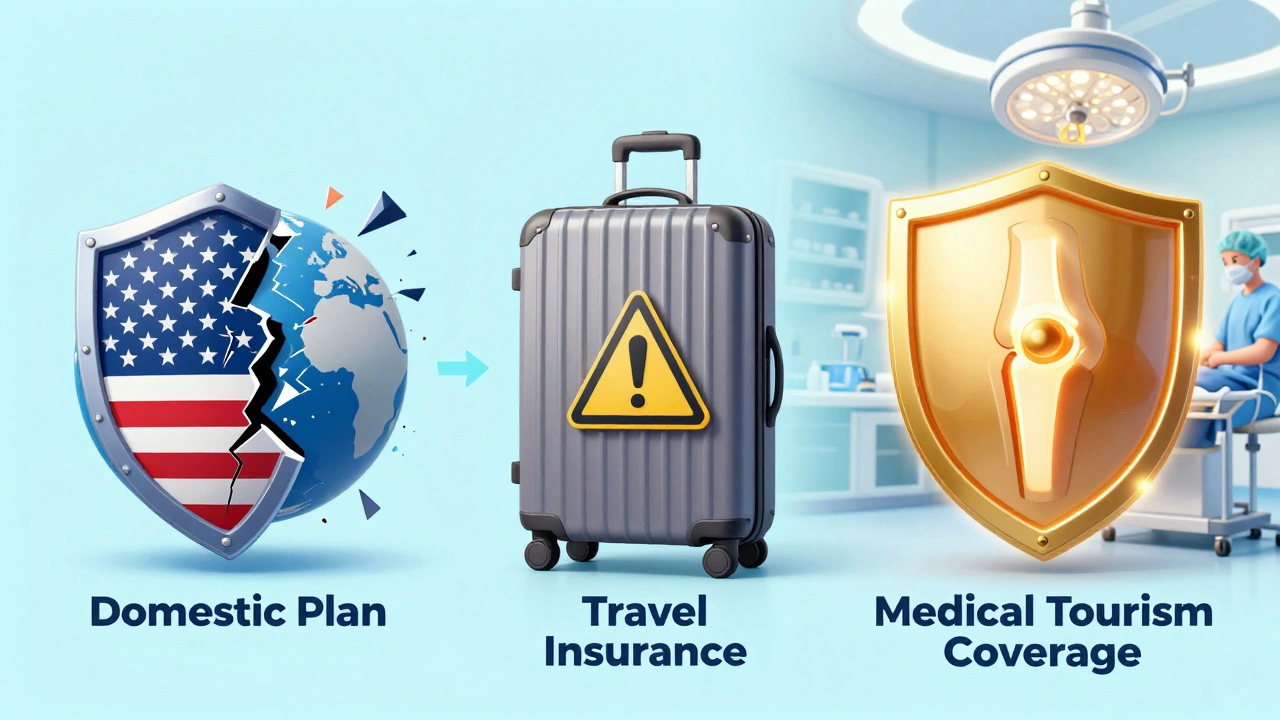
The Solution: Travel Medical Insurance vs. Primary Care
If your regular insurance won't work, what should you buy? This is where people get confused. There are two distinct products, and picking the wrong one can cost you thousands.
| Feature | Standard Travel Insurance | Specialized Medical Tourism Insurance | Primary US Health Plan |
|---|---|---|---|
| Covers Pre-existing Conditions? | Rarely (unless waived) | Sometimes (case-by-case) | Yes (but not abroad) |
| Covers Planned Surgery? | No | Yes | No |
| Covers Emergency Evacuation? | Yes | Yes | Limited/Rare |
| Pays Hospitals Directly? | Usually No (Reimbursement) | Often Yes (Guaranteed Payment) | No |
| Best For... | Vacations, accidents | Knee replacements, dental, IVF | Daily care in the US |
Standard Travel Insurance is designed for vacations. It covers trip cancellation, lost luggage, and unexpected accidents (like breaking your leg skiing). It explicitly excludes pre-existing conditions and planned treatments. If you go to Thailand for a scheduled hip replacement and buy standard travel insurance, you will not be covered.
Specialized Medical Tourism Insurance is a niche product offered by brokers who specialize in cross-border care. These policies are tailored to cover the specific procedure you are undergoing. They often include guarantees that the foreign hospital will perform the surgery to a certain standard, and they may cover complications that arise after you return home. Companies like AllClear ID or specialized brokers in India and Thailand offer these plans. They are more expensive than standard travel insurance but are essential for elective care.
Navigating the Claims Process
Let's say you did the right thing and bought a specialized policy. How does the money actually move? In the US, you are used to showing your card and getting a bill later. Abroad, the system is different.
Most international arrangements require upfront payment. Even with insurance, you may need to pay the deposit or the full balance before discharge. Your insurance broker then acts as an intermediary. They verify the treatment with the hospital, process the claim, and reimburse you. This can take 30 to 90 days. Make sure you have enough liquid cash or credit limit to cover the entire procedure upfront.
Documentation is critical. Keep every receipt, every medical record, and every correspondence with the doctor. Translate all documents into English if they aren't already. Insurers reject claims constantly because of missing paperwork. If you undergo a dental implant in Mexico, ensure the dentist provides a detailed itemized bill separating materials, labor, and anesthesia.
Hidden Risks Beyond the Bill
Money is only part of the equation. Using US insurance abroad fails to address three major risks:
- Complications After Return: If you have surgery in Bali and develop an infection two weeks later in Ohio, who pays for the follow-up care? Standard US plans may deny this as related to an unapproved foreign procedure. Specialized medical tourism insurance often includes "post-treatment complication" coverage for 180-365 days after you return.
- Medical Evacuation Costs: If your condition worsens and the local hospital cannot handle it, you may need a medical jet to fly you to Singapore or back to the US. This can cost $50,000 to $150,000. Without a policy that includes emergency medical evacuation, you are personally liable for this entire sum.
- Quality Disputes: If the surgery fails, suing a foreign hospital is nearly impossible for a US citizen. Reputable medical tourism facilitators often have legal partnerships with hospitals to guarantee outcomes, but your health insurance company has no leverage here.

Step-by-Step Checklist for Protected Travel
Before you book any appointment abroad, run through this list:
- Contact your primary insurer: Ask specifically: "Do you cover elective procedures performed in [Country]?" Get the answer in email or writing. Do not trust verbal assurances.
- Verify hospital accreditation: Ensure the foreign hospital is accredited by JCI (Joint Commission International) or equivalent. This matters for both quality and insurance validation.
- Buy specialized coverage: Purchase a medical tourism insurance policy that covers the specific procedure, pre-existing conditions, and post-return complications.
- Confirm direct billing: Ask the hospital if they have a "guarantee of payment" agreement with your insurance broker. This reduces your upfront financial risk.
- Plan for follow-up: Schedule a check-up with your local US doctor before you leave. Establish a baseline so any changes can be documented as related to the foreign procedure.
FAQ
Will Medicare cover me if I travel abroad?
Generally, no. Original Medicare (Parts A and B) does not cover health care services received outside the United States, except in very rare situations, such as if you are in the US and a medical emergency occurs in Canada before you can get back to the nearest US hospital. Most seniors need a separate Medigap plan or private travel insurance for international trips.
What if I have a catastrophic accident while on vacation?
If it is a true emergency (not planned), your US health insurance may cover it, but you will likely have to pay upfront and file for reimbursement. However, coverage limits for international care are often low. A dedicated travel medical insurance policy is much safer for high-cost emergencies like helicopter rescues or ICU stays.
Can I use my FSA or HSA funds for surgery abroad?
Yes. Funds from a Flexible Spending Account (FSA) or Health Savings Account (HSA) can be used for qualified medical expenses regardless of where the service is provided, including abroad. Keep detailed receipts and proof of payment to substantiate the expense for tax purposes.
Is it cheaper to just pay out of pocket without insurance?
For simple procedures like dental cleanings or basic LASIK, paying out of pocket might be simpler and cheaper than buying specialized insurance. However, for major surgeries like joint replacements or cardiac care, the risk of complications is too high. The cost of a medical evacuation or treating a severe infection in the US can easily exceed $100,000, making insurance a necessary safety net.
How do I find a reputable medical tourism insurance provider?
Look for brokers who specialize in cross-border care rather than general travel agents. Search for providers that partner directly with JCI-accredited hospitals. Read reviews specifically mentioning claim payouts for complications, not just smooth trips. Avoid generic travel insurance packages sold by airlines or booking sites, as they exclude pre-existing conditions and planned treatments.