
You’ve been feeling off for weeks. Maybe you’re crying more than usual, or you’ve stopped calling friends. Maybe you’re sleeping too much-or not at all. You scroll through social media and wonder if everyone else has it together except you. Then comes the question: Do I need counseling or therapy? It’s not a silly question. It’s one of the most important ones you can ask yourself.
What’s the difference between counseling and therapy?
People use these words like they’re the same, and honestly, in everyday talk, they often are. But there’s a small but meaningful difference.
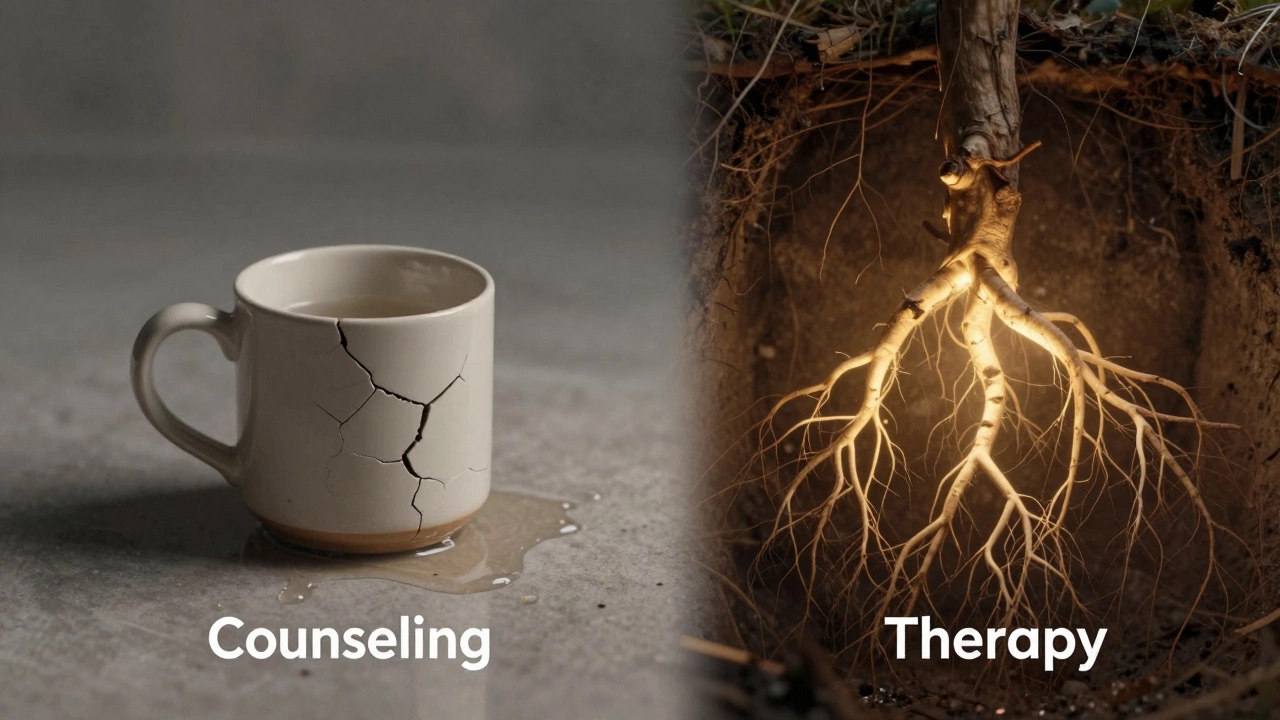
Counseling is usually short-term and focused on a specific issue. Think of it like fixing a flat tire. You’re dealing with a breakup, job stress, grief after losing a pet, or adjusting to a new city. A counselor helps you work through that one thing, build coping tools, and get back on track. Most counseling lasts a few weeks to a few months.
Therapy, especially psychotherapy, goes deeper. It’s not just about solving a problem-it’s about understanding how you got there. If you’ve struggled with low self-worth since childhood, if you keep repeating toxic relationship patterns, or if you feel numb most days even when things seem fine-therapy helps you unpack that. It often takes longer, sometimes years, and involves exploring your past, beliefs, and emotional habits.
Think of counseling as fixing the surface. Therapy is rewiring the foundation.
Signs you might need counseling
You don’t need to be in crisis to benefit from counseling. Here are common situations where it helps:
- You’re overwhelmed by a recent life change-new job, divorce, moving, becoming a parent.
- You’re having trouble managing stress at work or school, and it’s affecting your sleep or appetite.
- You lost someone close and can’t seem to move forward after six months.
- You’re arguing more with your partner or family and don’t know why.
- You feel stuck in a rut and can’t figure out how to change it.
Counseling doesn’t mean something’s wrong with you. It means you’re trying to handle something hard, and you’re smart enough to ask for help.
Signs you might need therapy
Therapy is for when the pain runs deeper and lasts longer. These signs suggest it’s time to look beyond quick fixes:
- You’ve felt empty, hopeless, or numb for more than two weeks, even when things are going well.
- You have panic attacks, intense anxiety, or fear of leaving your house.
- You self-harm, binge drink, or use food, drugs, or sex to numb emotions.
- You have recurring nightmares, flashbacks, or feel like you’re reliving trauma.
- You’ve tried counseling before, but the same issues keep coming back.
- You feel like you’re wearing a mask all the time-and you’re tired of pretending.
Therapy isn’t just for people with "serious" problems. It’s for anyone who wants to understand why they react the way they do-and change it.
What happens in a session?
First session? Don’t expect to be analyzed on the spot. Most therapists start by asking you to tell your story. What’s been going on? When did it start? What have you tried so far?
In counseling, you’ll likely get practical tools: breathing exercises, journaling prompts, communication scripts for tough conversations. You might be given homework-like tracking your mood for a week.
In therapy, it’s less about fixing and more about exploring. You might talk about your childhood, your relationship with your parents, or why you always choose partners who don’t show up. It’s not always comfortable. But that’s where the change happens.
Both are confidential. What you say stays between you and your provider. In India, there’s no legal requirement for therapists to report unless someone is in immediate danger.

How do you find the right person?
Not every therapist is right for every person. It’s like dating-you need chemistry.
Start by looking for licensed professionals. In India, look for someone registered with the Rehabilitation Council of India (RCI) or a recognized psychology association. Many private clinics in Bangalore, Delhi, and Mumbai have qualified counselors and clinical psychologists.
Ask yourself: Do they listen more than they talk? Do they make you feel safe, not judged? Do they explain things clearly? If you leave a session feeling worse or dismissed, it’s okay to try someone else.
Online therapy platforms like BetterHelp, MantraCare, and YourDOST are popular in India. They offer video sessions, messaging, and some even have Hindi and regional language options. Prices range from ₹800 to ₹3,000 per session, depending on experience and location.
What if you’re not sure?
That’s okay. You don’t need to have it all figured out before you reach out.
Try one session of counseling. If it helps, great. If you still feel stuck, that’s a signal to go deeper. Many therapists offer a free 15-minute call to see if you’re a good fit. Use that to ask: "What’s your approach? Have you worked with people like me?"
And remember: asking for help doesn’t make you weak. It makes you human.
Common myths about counseling and therapy
Let’s clear up some myths that keep people from getting help:
- "Therapy is only for crazy people." No. Over 1 in 4 Indians experience a mental health issue in their lifetime. Therapy is for anyone who wants to feel better.
- "I should be able to handle this on my own." You wouldn’t tell someone with a broken leg to just walk it off. Emotional pain needs care too.
- "My family will think I’m weak." Many families in India are starting to understand mental health. If they don’t yet, that’s their issue-not yours.
- "Therapy takes too long and costs too much." Some sessions cost less than a monthly phone bill. And many NGOs and government hospitals offer free or low-cost services in cities like Bangalore, Pune, and Hyderabad.
What if you can’t afford it?
Cost is a real barrier. But help exists.
In Bangalore, the National Institute of Mental Health and Neurosciences (NIMHANS) offers low-cost therapy through its outpatient clinic. Many universities with psychology departments-like Christ University and Bangalore University-run free counseling clinics for the public, staffed by trained students under supervision.
Non-profits like The Live Love Laugh Foundation and Vandrevala Foundation offer free helplines and subsidized sessions. You can also check out WhatsApp-based support services like iCall, which provides free emotional support in multiple languages.
Don’t let money stop you. Start small. One session can be a turning point.
What if you try it and it doesn’t work?
It’s not unusual to feel like therapy isn’t helping-at first. Sometimes it takes 3-5 sessions before you feel comfortable enough to open up. That’s normal.
But if after 6-8 sessions you still feel the same, or worse, it might be the fit. Don’t give up on therapy. Give up on that therapist and try someone else.
Some people need a different style: one therapist uses CBT (cognitive behavioral therapy), another uses psychodynamic approaches. One might be quiet and reflective; another might be more direct. Find your match.
It’s not about being broken-it’s about being human
You don’t need to be in ruins to deserve support. You don’t need to hit rock bottom to ask for help. You just need to be tired of hurting.
Counseling and therapy aren’t magic. They won’t erase your past or fix your life overnight. But they can give you back your voice, your clarity, your peace.
If you’re reading this and thinking, "Maybe I should try," then you already know the answer. You don’t need permission. You don’t need to wait for things to get worse. You’re allowed to want to feel better.
Take the first step. Call one clinic. Send one message. Book one session.
You’ve already done the hardest part-you asked the question.
Can counseling help with anxiety?
Yes, counseling is very effective for mild to moderate anxiety, especially when it’s tied to specific triggers like public speaking, job stress, or social situations. Counselors use techniques like breathing exercises, thought challenging, and exposure methods to help you manage symptoms quickly. If your anxiety is severe, persistent, or paired with panic attacks, therapy may be more appropriate.
Is therapy only for people with depression?
No. Therapy helps with a wide range of issues: relationship problems, grief, trauma, identity struggles, burnout, low self-esteem, and even feeling "empty" without a clear reason. Depression is just one of many reasons people seek therapy. Many people go to therapy just to understand themselves better-not because they’re sick, but because they want to live more fully.
How long does therapy usually last?
There’s no fixed timeline. Short-term therapy might last 6-12 sessions for a specific issue. Long-term therapy can go on for a year or more, especially if you’re working through deep-rooted patterns from childhood or trauma. Some people stay in therapy for years because they find it helpful, like going to a personal trainer for mental fitness.
Can I do therapy online?
Absolutely. Online therapy is widely available in India and has become just as effective as in-person sessions. Platforms like MantraCare, YourDOST, and iCall offer video calls, chat, and even voice messages. Many people prefer online therapy because it’s more private, flexible, and eliminates travel time-especially helpful in busy cities like Bangalore.
What if I’m scared to talk to a stranger?
It’s completely normal to feel nervous. Most therapists expect this. The first session is often just about getting comfortable. You don’t have to share everything at once. Many people start by saying, "I’m not sure where to begin," and that’s enough. A good therapist will meet you where you are-not push you faster than you’re ready.
Will people judge me if they find out I’m in therapy?
Some might, but that says more about them than you. Mental health is becoming less stigmatized in India, especially among younger generations. Many professionals, students, and even parents are now openly talking about therapy. You don’t owe anyone an explanation. Your healing is your business.