Rare Mental Disorder Explorer
Select a rare psychiatric condition to learn about its core delusion, prevalence, and neurological basis.
Imagine waking up one morning and being absolutely certain that you are dead. Your heart isn't beating. Your lungs aren't breathing. You are a ghost haunting your own life. This isn't a scene from a horror movie; it is the terrifying reality for individuals living with Cotard's syndrome, also known as walking corpse syndrome. It is widely considered one of the rarest and most bizarre mental disorders in modern psychiatry. But is it truly the rarest? And what other strange conditions exist on the fringes of human psychology?
The concept of "rarity" in mental health is tricky. Unlike genetic disorders with clear biological markers, many psychiatric conditions are defined by subjective experiences and complex brain network failures. However, when we look at documented cases in medical literature, a few contenders stand out for their extreme scarcity and profound impact on perception. Today, we will explore these ultra-rare conditions, understand why they happen, and look at how people live with them.
The Walking Corpse: Cotard's Syndrome
If you had to pick a single title for the rarest mental disorder, Cotard's syndrome usually takes the crown. First described by French neurologist Jules Cotard in 1880, this condition involves a nihilistic delusion where the patient believes they are dead, do not exist, or have lost their blood or internal organs. Some patients believe the world itself has ceased to exist.
This is not just sadness or depression taking a dark turn. It is a complete break from shared reality. Patients may stop eating because they believe they no longer need food. They might refuse medical care because they think their body is already rotting. In severe cases, this can lead to exposure to the elements or self-harm, driven by the conviction that pain is impossible because they are already deceased.
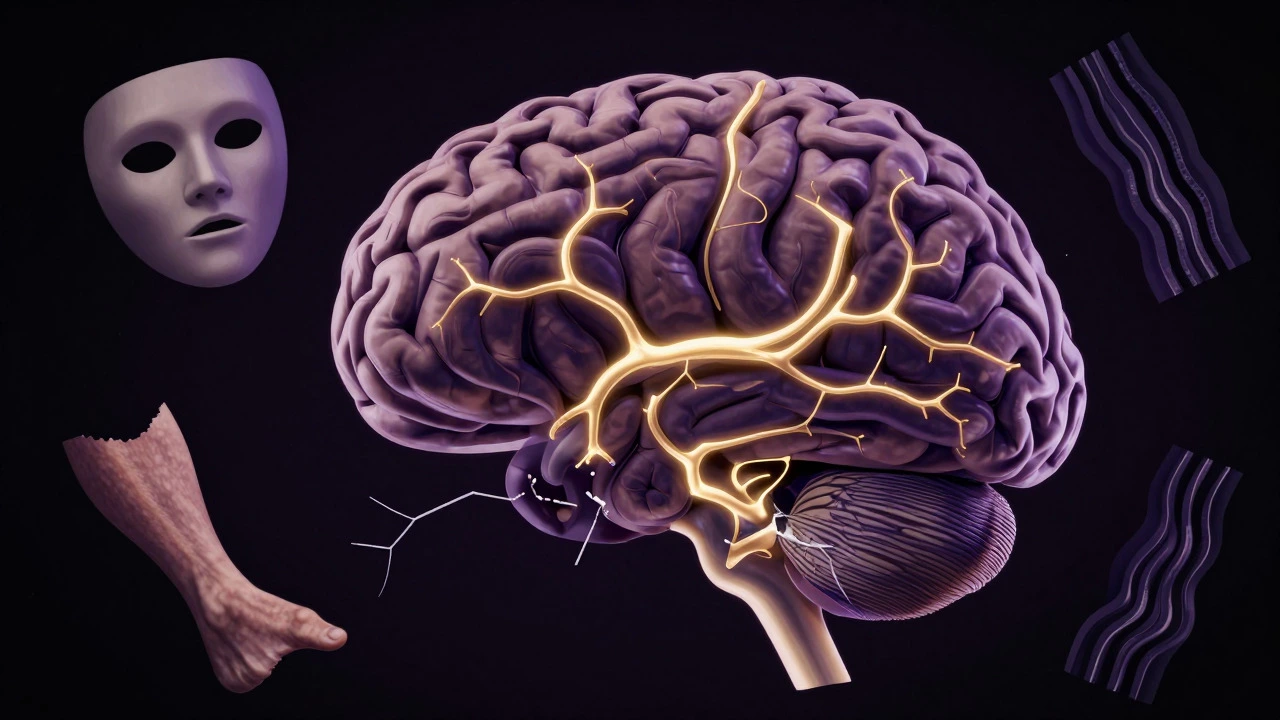
Why does this happen? Neuroimaging studies suggest that Cotard's syndrome results from a disconnect between different parts of the brain. Specifically, there seems to be a failure in the integration of information from the parietal lobe (which processes spatial awareness) and the limbic system (which handles emotion). When these areas stop talking to each other properly, the brain fails to attach emotional significance to sensory input. The result? A person who sees themselves in the mirror but feels nothing-leading the mind to conclude, "I must not be real."
| Disorder Name | Core Delusion/Belief | Estimated Prevalence | Common Comorbidities |
|---|---|---|---|
| Cotard's Syndrome | I am dead / I do not exist | Extremely Rare (<1% of psych patients) | Severe Depression, Schizophrenia |
| Capgras Delusion | Close ones are impostors | Rare (More common than Cotard's) | Schizophrenia, Dementia, Brain Injury |
| Fregoli Delusion | Strangers are familiar people in disguise | Very Rare | Schizophrenia, Temporal Lobe Epilepsy |
| Apotemnophilia | Healthy limbs are alien/wrong | Rare | OCD, Body Dysmorphic Disorder |
The Impostor Syndrome: Capgras Delusion
While Cotard's syndrome turns inward, destroying the sense of self, Capgras delusion attacks our relationships with others. People with this condition believe that a friend, spouse, parent, or pet has been replaced by an identical-looking impostor. You might sit across from your husband of twenty years, see his face, recognize his features, but feel zero emotional connection. Your brain screams, "That is not him! That is a fake!"
Capgras is technically more common than Cotard's, particularly among patients with schizophrenia or Alzheimer's disease, but it remains incredibly rare in the general population. The mechanism behind it offers a fascinating glimpse into how our brains process faces. We have two pathways for facial recognition: one identifies the physical features (the "what"), and another generates the emotional familiarity (the "feeling"). In Capgras, the visual pathway works fine-you recognize the face-but the emotional pathway is broken. The lack of warmth or recognition triggers a rationalization: "It looks like my wife, but it doesn't feel like her, so it must be a copycat trying to trick me."

Other Notable Rare Conditions
Beyond the big two, there are several other disorders that challenge our understanding of identity and reality. While less famous, they are equally compelling.
Fregoli Delusion: This is essentially the opposite of Capgras. Individuals believe that different people they encounter are actually a single person who changes appearance or wears a disguise to persecute or follow them. A stranger on the bus? It's your ex-boss in disguise. The cashier? Still the same person. This often stems from hyper-familiarity without correct identification, linked to damage in the right hemisphere of the brain.
Apotemnophilia (Body Integrity Identity Disorder): Here, a healthy individual becomes obsessed with becoming disabled. They feel that one or more of their healthy limbs do not belong to them. It is not about self-harm in the traditional sense; it is about alignment. Many sufferers report a deep sense of relief after amputation, suggesting the brain's map of the body was fundamentally mismatched with physical reality.
Foreign Accent Syndrome: Though often classified under neurological speech disorders, this has significant psychological impacts. After a stroke or head injury, a person begins speaking with a foreign accent. If they previously spoke only English, they might suddenly sound distinctly Irish or German. This happens due to damage to the motor cortex areas controlling speech rhythm and intonation. The psychological toll of losing one's voice identity is immense.
Why Are These Disorders So Rare?
You might wonder why we don't hear about these conditions every day. The answer lies in their specific neurological requirements. Most mental health issues, like anxiety or depression, involve broad networks of neurotransmitters (serotonin, dopamine) that affect millions of people. Rare disorders like Cotard's or Capgras require very specific structural or functional breaks in highly localized brain regions.
Furthermore, these conditions are almost always secondary. You rarely find someone with Cotard's syndrome who is otherwise perfectly healthy. It usually emerges during severe episodes of bipolar disorder, major depressive disorder with psychotic features, or following traumatic brain injuries. Because the underlying causes are treatable or manageable, the window in which these rare delusions appear is often short-lived if caught early.
Diagnosis and Treatment Challenges
Treating the rarest mental disorders is difficult because standard protocols often fall short. Antipsychotic medications can help reduce the intensity of delusions, but they rarely cure the underlying perceptual glitch. Electroconvulsive therapy (ECT) has shown surprising effectiveness in treating Cotard's syndrome, likely by resetting neural connectivity in the affected brain regions.
Therapy plays a crucial role too. Cognitive Behavioral Therapy (CBT) adapted for psychosis helps patients question their delusions gently. Instead of arguing, "You are alive," therapists might ask, "What evidence do you have that you are dead? And what evidence suggests you are alive?" This slow, logical approach helps rebuild the bridge between emotion and cognition.
Family support is critical. For a partner dealing with Capgras delusion, being called an impostor is heartbreaking. Education helps families understand that the rejection is not personal-it is a symptom of a broken wiring diagram in the brain. Patience and consistency are key to helping the patient maintain social bonds despite their distorted perceptions.
Living With the Unimaginable
For those diagnosed with these ultra-rare conditions, life is a constant negotiation with reality. Recovery is possible, especially if the underlying cause (like a vitamin deficiency, tumor, or infection) is addressed. Many patients return to normal functioning after treatment. Others manage long-term symptoms with medication and therapy.
Understanding these disorders reminds us of the fragility of our sense of self. Our identity, our relationships, and our perception of existence are not fixed truths-they are constructed by the brain in real-time. When that construction fails, even slightly, the consequences can be profound. Yet, through science and empathy, we continue to shed light on these shadows, offering hope to those trapped in the rarest corners of the mind.
Is Cotard's syndrome curable?
Yes, in many cases. Treatment depends on the underlying cause. If it stems from severe depression or schizophrenia, antipsychotics and antidepressants can help. Electroconvulsive therapy (ECT) has been particularly effective for Cotard's specifically, often resolving the delusion quickly by restoring neural connections.
What is the difference between Cotard's and Capgras?
Cotard's syndrome involves believing *you* are dead or nonexistent. Capgras delusion involves believing *others* (usually loved ones) have been replaced by impostors. Both involve a disconnect between visual recognition and emotional response, but they target different subjects: self vs. others.
How common are these rare mental disorders?
They are extremely rare. Exact numbers are hard to pin down because they are often misdiagnosed or recorded as part of broader conditions like schizophrenia. However, Cotard's syndrome is estimated to affect less than 1% of psychiatric patients, making it one of the rarest documented conditions.
Can brain injury cause these disorders?
Absolutely. Traumatic brain injuries, strokes, and tumors affecting the frontal or temporal lobes can trigger these delusions. Damage to the areas responsible for integrating emotion and memory disrupts the brain's ability to verify reality, leading to conditions like Capgras or Fregoli delusions.
Are these disorders dangerous?
They can be. Patients with Cotard's syndrome may neglect basic needs like eating or staying warm because they believe they are dead. Those with Capgras may become aggressive toward the "impostors" they perceive. Immediate medical attention is crucial to ensure safety and begin treatment.