ADHD & Autism Differentiation Quiz
Understand Your Symptoms
This quiz helps you understand if your symptoms align more with ADHD, autism, or both. Remember: This is not a diagnosis. Always consult a medical professional for proper evaluation.
ADHD Symptoms
Autism Symptoms
Your Results
Select your symptoms above and click "Calculate Results" to see your personalized analysis.
Many people wonder if ADHD is just another kind of autism. It’s a simple question, but the answer isn’t black and white. You might hear someone say, "My kid has ADHD and also seems autistic," or "My therapist says ADHD and autism are the same." But they’re not. They’re two separate conditions that sometimes show up together - and that’s where things get confusing.
What ADHD Really Is
ADHD - Attention-Deficit/Hyperactivity Disorder - is a neurodevelopmental condition that affects how the brain manages focus, impulse control, and energy levels. It’s not about being lazy or distracted on purpose. People with ADHD often struggle to sit still, finish tasks, or filter out background noise. Some are hyperactive; others are quietly inattentive. The core issue? Their brain’s executive functions - the mental system that plans, organizes, and regulates behavior - don’t work the same way as in neurotypical brains.
Studies show about 5% of children and 2.5% of adults have ADHD. Boys are diagnosed more often, but girls and women are frequently missed because their symptoms look different - daydreaming, forgetfulness, or emotional sensitivity instead of outbursts. Medications like methylphenidate or behavioral therapy can help, but there’s no cure. ADHD is lifelong, and it doesn’t go away just because you grow up.
What Autism Really Is
Autism, or Autism Spectrum Disorder (ASD), is a different kind of neurodevelopmental condition. It’s not a single trait, but a wide range of experiences. People with autism often have differences in how they process sensory input, communicate, and relate to others. Some are nonverbal. Others talk nonstop but struggle with social cues. Many have intense interests, rigid routines, or deep reactions to sounds, lights, or textures.
Autism shows up early - usually before age three. It’s not caused by parenting, vaccines, or diet. It’s genetic, with brain structure and connectivity differences that show up in scans. The CDC estimates about 1 in 36 children in the U.S. are diagnosed with autism. Unlike ADHD, autism isn’t treated with stimulant meds. Support comes from speech therapy, occupational therapy, social skills training, and sometimes behavioral interventions like ABA.
Why People Think They’re the Same
It’s easy to mix them up. Both conditions show up in childhood. Both can mean trouble in school. Both involve social challenges. A kid with ADHD might interrupt constantly. A kid with autism might not understand why interrupting is rude. Both might rock back and forth when stressed. Both might zone out during a conversation - one because they’re distracted, the other because they’re overwhelmed by the noise.
There’s also overlap in symptoms. Trouble with executive function? Common in both. Difficulty reading social signals? Yes, in both. Emotional outbursts? Happens in both. That’s why some parents hear, "Your child has ADHD," then later, "Actually, it’s autism." Or vice versa. The same child might get one diagnosis first, then the other months or years later.

The Research Says: They’re Separate, But Often Co-Occur
Here’s the key fact: ADHD and autism are not the same condition. They have different diagnostic criteria. ADHD is listed in the DSM-5 under "Neurodevelopmental Disorders," and so is autism - but they’re two separate entries.
Still, they show up together a lot. A 2023 meta-analysis of over 120 studies found that between 30% and 50% of people with autism also meet the criteria for ADHD. And about 20% to 30% of people with ADHD show signs of autism - especially in social communication and rigid thinking.
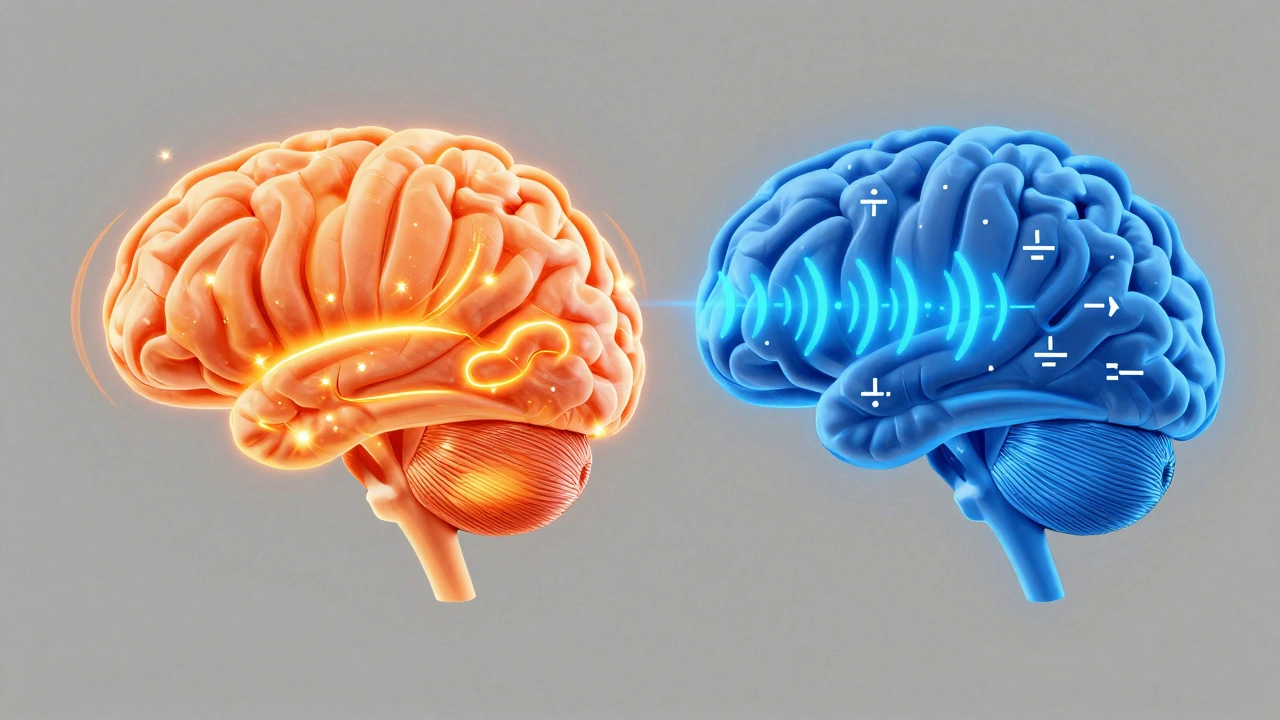
Why does this happen? Scientists think it’s because both conditions involve overlapping brain networks - especially areas that handle attention, emotional regulation, and social processing. Think of it like two different software glitches running on the same computer. One affects your focus system; the other affects your social filter. They’re separate, but they can crash together.
How Doctors Tell Them Apart
Diagnosing one without missing the other takes skill. A good clinician doesn’t just check boxes. They look at the full picture.
For ADHD, they ask: Does the person struggle to sustain attention? Are they impulsive? Do they fidget or feel restless? Is it happening in multiple settings - home, school, work?
For autism, they look deeper: Does the person have trouble with back-and-forth conversation? Do they repeat phrases or fixate on narrow topics? Do they get upset over small changes in routine? Do they react strongly to lights, smells, or touch? Do they miss social cues others pick up easily?
One big clue? People with autism often don’t want to socialize - they just don’t know how. People with ADHD often want to connect, but they blurt things out, forget names, or get distracted mid-conversation. That’s a subtle but important difference.
What Happens When Both Are Present?
When ADHD and autism co-occur, life gets harder - but also more understandable.
A child with both might:
- Have meltdowns because they can’t focus and the classroom is too loud
- Forget homework because they’re overwhelmed by sensory input
- Seem rude because they interrupt, not because they’re being mean - but they also don’t realize others are upset
- Struggle with transitions because their ADHD makes change hard, and their autism makes it terrifying
Treatment gets more complex. Stimulant meds for ADHD might help focus, but they can make sensory sensitivity worse. Behavioral therapy for autism might focus on social skills, but if the person can’t sit still, the therapy won’t stick. That’s why integrated care matters - therapists who understand both conditions, not just one.

Myths That Still Circulate
Let’s clear up some false ideas:
- Myth: "ADHD is just bad behavior."
Truth: ADHD is a brain-based condition, not a parenting failure. - Myth: "Autism is just extreme shyness."
Truth: Autism is about how the brain processes information, not social anxiety. - Myth: "If you have ADHD, you can’t be autistic."
Truth: Co-occurrence is common. In fact, it’s the rule, not the exception.
And here’s another big one: "You outgrow ADHD." No. You learn to manage it. And you don’t "outgrow" autism - you learn to live with it. Both are lifelong.
What Should You Do If You Suspect Both?
If you’re a parent, teacher, or adult wondering whether you or someone you care about has ADHD, autism, or both:
- Don’t self-diagnose. Online quizzes aren’t reliable.
- Seek a specialist: A child psychiatrist, developmental pediatrician, or clinical psychologist trained in neurodevelopmental disorders.
- Bring detailed examples: Not just "they’re distracted," but "they forgot their lunch three days in a row and got angry when I asked why."
- Ask about screening for both: Many clinics still screen for ADHD first - but ask if autism traits were considered too.
Early, accurate diagnosis changes everything. It means getting the right support - not just medication, but school accommodations, sensory tools, social coaching, or workplace adjustments.
The Bottom Line
ADHD is not autism. Autism is not ADHD. They’re two different conditions with different causes, different symptoms, and different treatments.
But they’re not mutually exclusive. In fact, they’re often twins in the brain - showing up together more than either shows up alone. Recognizing that can save years of confusion, mislabeling, and missed help.
If you’re wondering whether someone you love has one, the other, or both - don’t guess. Get evaluated. The right support doesn’t fix them. It helps them thrive.
Can ADHD and autism be diagnosed at the same time?
Yes. Since 2013, the DSM-5 - the official manual psychiatrists use - allows both ADHD and autism to be diagnosed together. Before that, doctors were told to pick one. Now, they know the two often overlap, and treating both gives better outcomes.
Do ADHD and autism have the same causes?
They share some genetic risk factors, but not all. Both are influenced by genes and early brain development, but autism has stronger links to specific gene mutations, while ADHD is tied more to dopamine regulation and frontal lobe function. Environmental factors like prematurity or prenatal exposure to toxins can increase risk for both.
Are the treatments for ADHD and autism the same?
No. ADHD is often treated with stimulant medications and behavioral strategies focused on organization and focus. Autism treatment focuses on communication, sensory regulation, and social skills - using speech therapy, occupational therapy, and sometimes behavioral interventions. If someone has both, treatment must address both sets of needs - and sometimes they conflict. For example, a stimulant might help focus but make sensory overload worse.
Can a person be diagnosed with autism as an adult?
Absolutely. Many adults - especially women and people assigned female at birth - weren’t diagnosed as children because their symptoms were quieter or masked. They might have been called "shy," "spacey," or "quirky." Now, with better awareness, more adults are getting evaluated and finally understanding why they’ve struggled for years.
Does having ADHD mean you’re on the autism spectrum?
No. ADHD is its own condition. While some people with ADHD have traits that look like autism - like social awkwardness or intense focus on hobbies - that doesn’t mean they’re autistic. Diagnosis requires meeting specific criteria for social communication and repetitive behaviors. Many people with ADHD don’t meet those criteria at all.