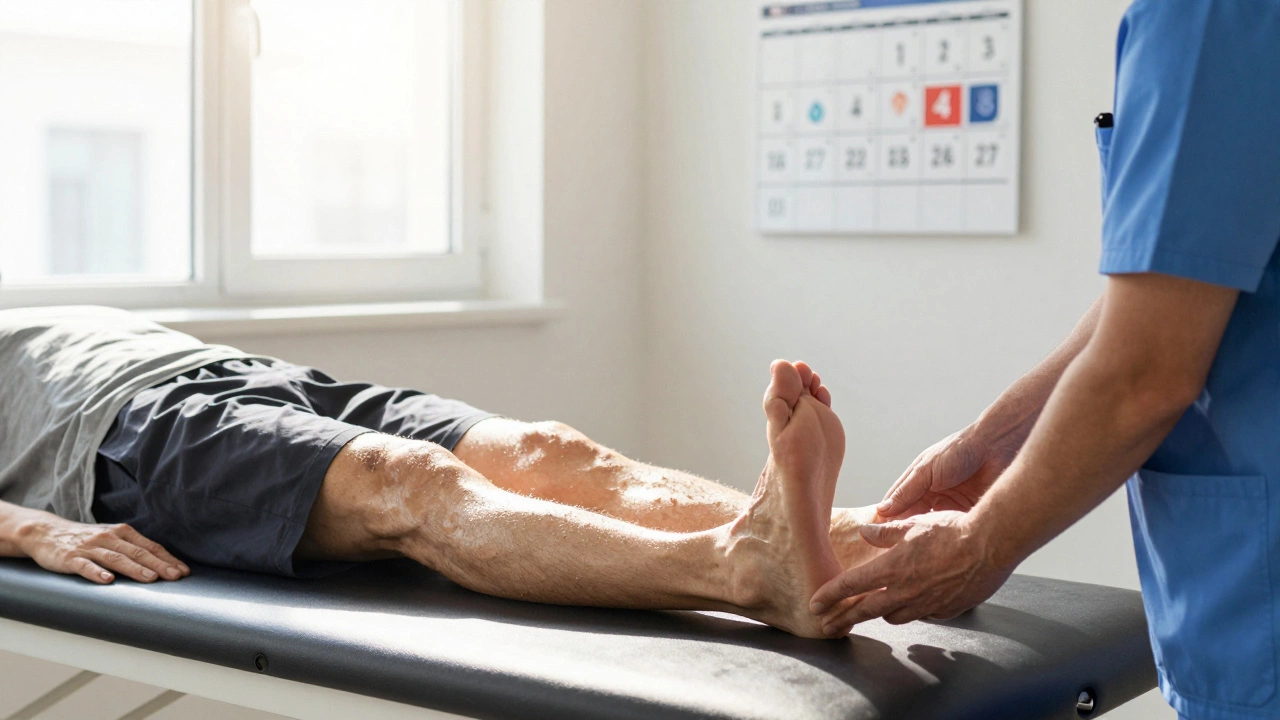
Knee Recovery Progress Tracker
Track Your Progress
Enter your current knee flexion angle and time since surgery to see how you're progressing
Next Steps
- Continue your prescribed physical therapy exercises daily
- Perform gentle stretching before activity
- Stay hydrated (aim for 2L water/day)
- Avoid prolonged sitting with knee bent
After knee replacement surgery, many people expect their knee to feel smooth and flexible right away. But the truth is, stiffness is common - and often lasts longer than patients hope. If you’re wondering whether this stiffness will ever go away, the answer isn’t simple. It depends on your body, your rehab, and how you handle the first few months after surgery.
Why does stiffness happen after knee replacement?
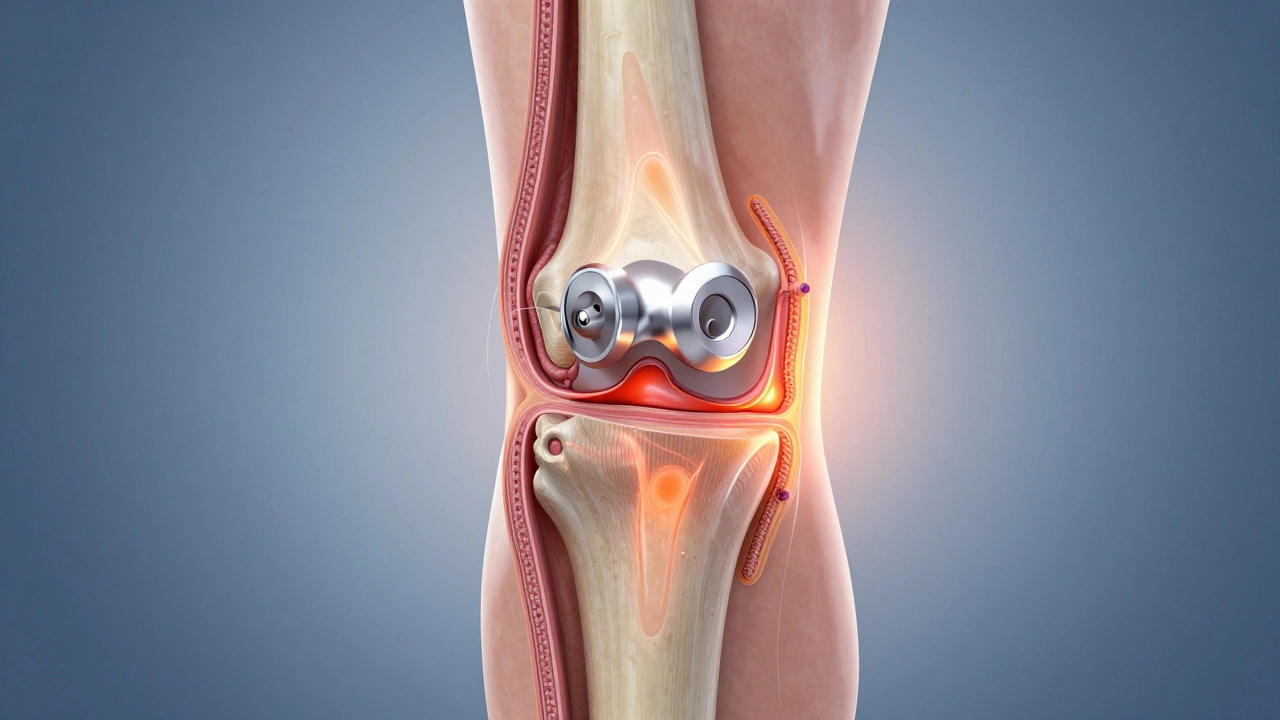
Your knee joint isn’t just bone and cartilage. It’s surrounded by ligaments, tendons, muscles, and a thick capsule that holds everything together. During surgery, this tissue gets cut, stretched, or repositioned. Even though the worn-out parts of the knee are replaced with metal and plastic, your body still needs time to heal around the new implant. Scar tissue forms as part of normal healing. That’s one of the main reasons stiffness shows up.
Another factor is muscle weakness. When you’ve been in pain for months or years before surgery, you likely stopped using your leg fully. The quadriceps and hamstrings shrink. Without strong muscles, your knee doesn’t move as smoothly - even if the implant itself is working perfectly.
Studies show that up to 30% of patients still report some stiffness six months after surgery. And about 1 in 5 still feel noticeable tightness after a year. But here’s the key: most of that stiffness can improve - if you do the right things.
When does stiffness start to improve?
The biggest changes happen in the first 12 weeks. That’s when your body is most responsive to movement. Physical therapy usually starts the day after surgery. Early motion is critical. If you don’t start bending and straightening your knee within the first few days, scar tissue can tighten up and become harder to break down later.
By week 4, most people can bend their knee to 90 degrees. By week 8, many reach 110-120 degrees - close to normal. Full extension (straightening) should be achieved by 6 weeks. If you’re not hitting these milestones, your therapist will adjust your routine. Delayed progress doesn’t mean failure. It just means you need to work smarter.
After 3 months, improvement slows down. But it doesn’t stop. Many patients report continued gains in flexibility up to 12 months. A 2023 study in the Journal of Orthopaedic Research tracked 400 patients for two years. Those who stuck with daily stretching and light activity saw an average 15% improvement in range of motion between months 6 and 18.
What can you do to reduce stiffness?
Stiffness doesn’t vanish on its own. You have to fight for it. Here’s what works:
- Move daily - Even if it’s painful. Walking 15-20 minutes twice a day helps more than sitting still.
- Do your prescribed exercises - Heel slides, seated knee bends, and straight leg raises aren’t optional. They rebuild strength and break scar tissue.
- Use heat before activity - A warm towel or heating pad for 10 minutes loosens the joint before stretching.
- Stretch before bed - Gentle stretching at night helps prevent morning stiffness.
- Stay hydrated - Dehydration makes connective tissue stiffer. Drink at least 2 liters of water daily.
- Avoid long periods of sitting - Sitting for more than an hour with your knee bent can cause tightening. Get up, walk, and stretch every 45 minutes.
Some people try massage or foam rolling. These can help with muscle tightness, but they won’t fix joint stiffness. Don’t rely on them alone.
What if stiffness doesn’t improve after 6 months?
If you’ve been consistent with rehab and still can’t bend your knee past 90 degrees after six months, it’s time to dig deeper. Two things could be going on:
- Excessive scar tissue (arthrofibrosis) - This is when the body overproduces scar tissue inside the joint. It feels like a wall blocking movement. A physical therapist can often identify this by how your knee resists motion. If confirmed, a doctor may recommend a manipulation under anesthesia (MUA) - a quick procedure where the knee is gently forced to move while you’re asleep. Studies show MUA restores motion in 85% of cases when done before 6 months.
- Implant positioning issues - Rarely, the new knee components aren’t aligned perfectly. This can cause mechanical blockage. An X-ray or CT scan can check this. If the implant is out of place, revision surgery may be needed.
Don’t wait. If you’re still stiff after 6 months, see your surgeon. The longer you wait, the harder it is to fix.
Can you get full range of motion?
Most people can achieve near-normal movement. Full extension (straight leg) is usually possible. Full flexion (bending) varies. A healthy knee bends about 135 degrees. After replacement, most patients reach 110-125 degrees. That’s enough for sitting, climbing stairs, and getting in and out of cars.
Some people - especially those who were very stiff before surgery - may never get past 100 degrees. But that doesn’t mean they’re limited. Many adapt. You don’t need 135 degrees to live well. One patient I spoke to, a 68-year-old grandmother from Chennai, couldn’t bend past 105 degrees but still gardens, cooks, and plays with her grandchildren. She learned to adjust her posture. That’s the real goal: function, not perfection.

What about long-term stiffness?
Stiffness that lasts beyond two years is unusual - but not impossible. If you still feel tightness after 24 months, it’s likely due to muscle weakness, poor posture, or lack of activity - not the implant. Many people stop exercising once the pain goes away. That’s when stiffness creeps back.
Long-term mobility depends on lifelong habits:
- Keep walking regularly
- Do light strength training twice a week
- Practice yoga or tai chi for flexibility
- Maintain a healthy weight - every extra pound adds pressure on the knee
There’s no expiration date on recovery. Your knee will stay flexible as long as you keep moving.
What about pain vs. stiffness?
Stiffness and pain aren’t the same. Pain means something’s wrong - inflammation, infection, or implant failure. Stiffness is usually just tightness. If your knee feels stiff but not painful, that’s normal. If it’s stiff and burning, hot, swollen, or throbbing - call your doctor. Those are red flags.
One patient in Bangalore came in with stiffness and swelling 10 months after surgery. She thought it was normal. Turns out, she had a low-grade infection. It was caught early because she didn’t ignore the warning signs. Always check with your surgeon if you’re unsure.
Final thoughts: Does stiffness go away?
Yes - for most people, stiffness does go away. But it doesn’t happen overnight. It takes patience, consistency, and effort. The first 3 months are critical. The next 9 months are about building habits. After a year, your knee should feel strong, stable, and much more mobile than before surgery.
If you’re still stiff, don’t give up. Talk to your therapist. Ask your surgeon. Keep moving. Your knee replacement isn’t just a fix - it’s a second chance. And like any second chance, it only works if you show up for it.