IVF Eligibility Pre-Screening Tool
This tool helps you identify potential barriers based on general clinical guidelines. It is not a medical diagnosis. Please consult your reproductive endocrinologist for personalized advice.
Enter your details to see preliminary results.
You’ve tried everything. The tracking apps, the timed intimacy, maybe even some basic medication. Now, you’re looking at in vitro fertilization (IVF) as your next big step. But before you book that consultation or transfer your savings, there’s a hard truth: not everyone is a candidate for this procedure. It’s not just about wanting a baby; it’s about whether your body can safely handle the process and whether the odds are in your favor.
IVF is complex, expensive, and physically demanding. Clinics don’t turn people away to be difficult-they do it because proceeding could lead to failed cycles, serious health risks, or wasted money. If you’re wondering why a doctor might say "no" or "not yet," here is what actually disqualifies you from IVF, broken down by medical reality rather than myth.
Your Age and Ovarian Reserve Are Primary Barriers
Let’s start with the elephant in the room: biology. While many clinics advertise "IVF for everyone," success rates drop sharply after age 40. This isn’t arbitrary. As women age, the quantity and quality of eggs decline. By the time you hit 43 or 44, the chance of getting a healthy live birth using your own eggs in a single cycle can drop below 5%.
Clinics often use two specific metrics to decide if you’re too old or have too low an ovarian reserve:
- Anti-Müllerian Hormone (AMH): This hormone indicates how many eggs you have left. An AMH level below 0.5 ng/mL suggests very low reserve. Some clinics will still try, but others may recommend donor eggs instead.
- Follicle-Stimulating Hormone (FSH): High baseline FSH levels (often above 10-15 mIU/mL on day 3 of your cycle) mean your brain is screaming at your ovaries to work harder because they’re struggling. If your FSH is consistently high, stimulation protocols might fail to produce enough eggs.
If you are over 42 with low AMH and high FSH, many reputable centers will tell you that IVF with your own eggs is statistically unlikely to succeed. They won’t necessarily ban you forever, but they might pause your treatment to discuss donor eggs or adoption.
Unmanaged Chronic Health Conditions Pose Serious Risks
Pregnancy puts massive stress on the heart, kidneys, and liver. If you have uncontrolled chronic conditions, carrying a pregnancy-even one achieved via IVF-could be life-threatening. Doctors look for stability before clearing you.
Here are common red flags:
- Uncontrolled Diabetes: High blood sugar damages blood vessels and increases the risk of miscarriage and birth defects. If your HbA1c is consistently above 7%, most clinics will delay IVF until you bring it under control.
- Severe Hypertension: High blood pressure that doesn’t respond to medication can lead to preeclampsia, a dangerous condition during pregnancy. If your BP remains unstable despite treatment, IVF might be postponed.
- Thyroid Disorders: Untreated hypothyroidism or hyperthyroidism interferes with ovulation and implantation. Your TSH levels need to be within a narrow range (usually between 0.5 and 2.5 mIU/L) before starting a cycle.
- Heart Disease: Certain congenital or acquired heart conditions make the fluid shifts of IVF and the strain of pregnancy too risky. A cardiologist must clear you explicitly.
The key word here is "unmanaged." Having diabetes doesn’t disqualify you. Having uncontrolled diabetes does. Work with your specialists first; IVF comes second.
Uterine Abnormalities Can Prevent Implantation
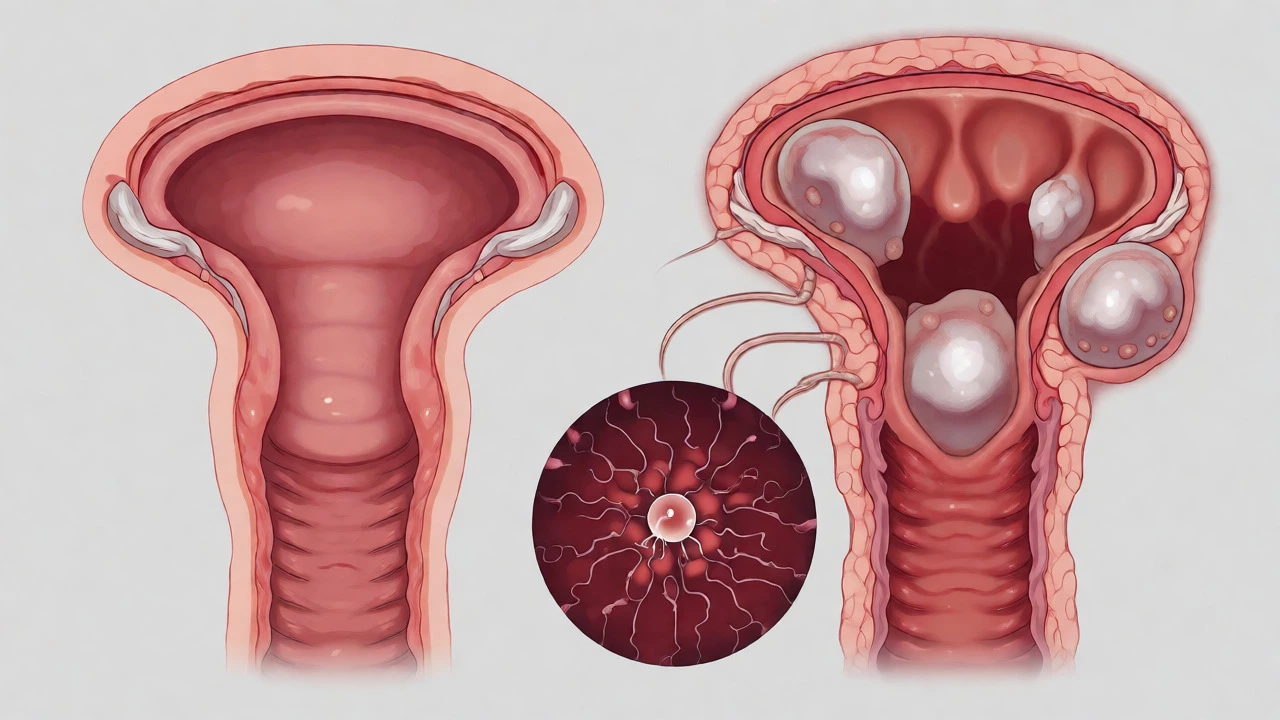
Think of the uterus as the soil where the seed implants. If the soil is rocky or toxic, nothing grows. Structural issues in the uterus are among the most common reasons for IVF failure, so doctors screen for them aggressively.
| Condition | Impact on IVF | Typical Resolution |
|---|---|---|
| Large Fibroids | Distort uterine cavity, blocking embryo attachment | Surgical removal (myomectomy) |
| Endometrial Polyps | Create inflammation, preventing implantation | Hysteroscopic removal |
| Asherman’s Syndrome | Scar tissue causes adhesions, reducing space | Adhesiolysis surgery |
| Septate Uterus | Divided cavity reduces functional space | Hysteroscopic septum resection |
If you have small fibroids that don’t touch the lining, you might proceed. But large submucosal fibroids? Those usually require surgery before you spend thousands on egg retrieval. Ignoring this step is like planting a garden in concrete.
Infection and Inflammation Must Be Cleared First
Active infections are absolute temporary disqualifiers. Why? Because introducing bacteria into the uterus during embryo transfer can cause severe pelvic inflammatory disease (PID), which can damage tubes further and ruin future chances.
- Untreated STIs: Chlamydia and gonorrhea must be fully treated and cured. A positive test means no cycle starts.
- Hydrosalpinx: This is a blocked fallopian tube filled with fluid. Paradoxically, having blocked tubes is fine for IVF (since we bypass them), but if those tubes are swollen with toxic fluid, that fluid can leak back into the uterus and wash out the embryo. Studies show hydrosalpinx cuts IVF success rates by half. Removal or clipping of the tubes is often required before transfer.
- Chronic Endometritis: Low-grade infection of the uterine lining. It’s silent but harmful. Antibiotic courses are needed to clear it.
Lifestyle Factors Play a Surprising Role
You might think, "I’m healthy, I run marathons." Great. But extreme fitness isn’t always ideal for fertility. Conversely, being significantly overweight or underweight affects hormones and drug metabolism.
BMI Matters: Most clinics prefer a Body Mass Index (BMI) between 19 and 35. Here’s why:
- BMI > 35: Higher doses of stimulation drugs are needed, ultrasound visibility drops, and risks of gestational diabetes and preeclampsia skyrocket. Many insurance plans and clinics set a BMI cap of 35-40.
- BMI < 19: Low body fat can stop ovulation entirely. Your body thinks it’s starving and shuts down reproduction.
Smoking and Alcohol: Smoking ages your ovaries faster. It reduces egg count and increases miscarriage rates. Most clinics require patients to quit smoking at least three months before starting IVF. Heavy alcohol consumption also lowers success rates. If you smoke heavily, some clinics will refuse to treat you until you commit to quitting.
Genetic and Male Factor Considerations
It’s not just about the woman. Severe male factor infertility can sometimes complicate things, though modern techniques like ICSI (Intracytoplasmic Sperm Injection) solve most sperm issues. However, certain genetic conditions in either partner might require preimplantation genetic testing (PGT), which adds cost and complexity.
If a couple carries a balanced translocation or a specific hereditary disease, standard IVF might result in embryos that don’t survive. Without access to PGT-A or PGT-M testing, some clinics might advise against IVF if the financial burden is too high relative to the chance of success.
Psychological Readiness Is Often Overlooked
This is subjective, but real. IVF is emotionally brutal. If you are currently experiencing severe untreated depression or anxiety, adding the hormonal rollercoaster of IVF can worsen mental health. Some clinics mandate a counseling session before starting. If you feel overwhelmed, taking a break isn’t a disqualification-it’s a smart strategy.
Financial Constraints: The Silent Disqualifier
Let’s be honest. IVF costs money. In India, a single cycle can range from ₹1.5 lakh to ₹3 lakh depending on the city and clinic. Add medications, testing, and potential multiple cycles, and the bill climbs fast.
While not a medical disqualification, lack of funds stops many treatments. If you cannot afford at least two cycles plus contingency, you might be better off waiting and saving. Starting a cycle you can’t finish halfway through is heartbreaking and costly.
Key Takeaways
- Age and Egg Quality: Advanced maternal age (>42) with low AMH/high FSH often leads to recommendations for donor eggs rather than own-egg IVF.
- Health Stability: Uncontrolled diabetes, hypertension, or thyroid issues must be managed before starting.
- Uterine Health: Large fibroids, polyps, or hydrosalpinx often require surgical correction prior to embryo transfer.
- Lifestyle: Extreme BMI variations and active smoking are major barriers to success and may lead to clinic refusal.
- Infections: Active STIs or uterine infections must be cleared completely.
FAQs About IVF Disqualification
Can you get IVF if you have no uterus?
No, traditional IVF requires a uterus for implantation. If you were born without a uterus or had a hysterectomy, you would need a surrogate (gestational carrier) who carries the embryo created from your eggs and your partner’s sperm. This is a different legal and medical pathway than standard IVF.
Does PCOS automatically disqualify me from IVF?
Absolutely not. Polycystic Ovary Syndrome (PCOS) is actually one of the most common reasons women undergo IVF. Women with PCOS often have plenty of eggs, so they respond well to stimulation. The challenge is managing Ovarian Hyperstimulation Syndrome (OHSS). With proper protocol adjustments, PCOS patients often have good IVF outcomes.
At what age do clinics stop offering IVF?
There is no universal cutoff. Many clinics will attempt IVF up to age 45-50 using donor eggs. For own-egg IVF, many centers become cautious after 42-43 due to low success rates. Some public healthcare systems have stricter age limits (e.g., under 40) for funded cycles, while private clinics may offer treatment beyond that based on individual health assessments.
Can men be disqualified from IVF?
Rarely. Men with zero sperm count (azoospermia) can often still father children via surgical sperm extraction (TESE/PESA) combined with ICSI. Disqualification might occur if the man has untreated sexually transmitted infections or severe systemic health issues that prevent him from providing a sample or supporting the process, but sperm quality alone rarely blocks IVF thanks to ICSI technology.
Do I need to lose weight before IVF?
If your BMI is over 35, yes, most clinics strongly advise weight loss. Excess weight increases medication needs, complicates ultrasounds, raises miscarriage risks, and increases pregnancy complications. Losing just 5-10% of body weight can significantly improve IVF success rates and safety.
Next Steps: What To Do If You’re Flagged
If a doctor tells you that something disqualifies you, don’t panic. "Disqualified" often means "Not Right Now." Ask these questions:
- Is this permanent or temporary? Can I fix my thyroid or remove this polyp?
- What are my alternatives? Should I consider donor eggs, surrogacy, or adoption?
- How long will the fix take? Weight loss takes months; surgery recovery varies.
- Are there other clinics? Different centers have different risk tolerances. Get a second opinion if you feel dismissed unfairly.
IVF eligibility is a moving target. Your body changes, treatments evolve, and new technologies emerge. Stay informed, stay healthy, and keep the conversation open with your reproductive endocrinologist.