Nerve Damage Recovery Tracker
How to Use This Tool
Rate your nerve damage symptoms on a scale of 1-10 (1 = no symptoms, 10 = worst possible symptoms). This will help you track your recovery progress over time.
What to Expect During Recovery
4-8 weeks: Reduced tingling and burning
3-6 months: Improved movement and sensation
After 6 months: Continued improvement if symptoms persist
Your Recovery Progress
You've recorded 0 symptom logs so far.
Average symptom score: N/A
Trend: No data recorded
Remember: Nerve healing takes time. Consistency is key. Track your symptoms regularly to see progress.
When nerves get damaged-whether from diabetes, injury, surgery, or chronic pressure-you don’t just feel tingling or pain. You lose sensation, strength, or control. And while some damage heals on its own, many people wonder: what is the best vitamin to repair nerve damage? The answer isn’t one single supplement. It’s a combination of nutrients that work together to support nerve regeneration, reduce inflammation, and restore function.
Why nerves need specific nutrients to heal
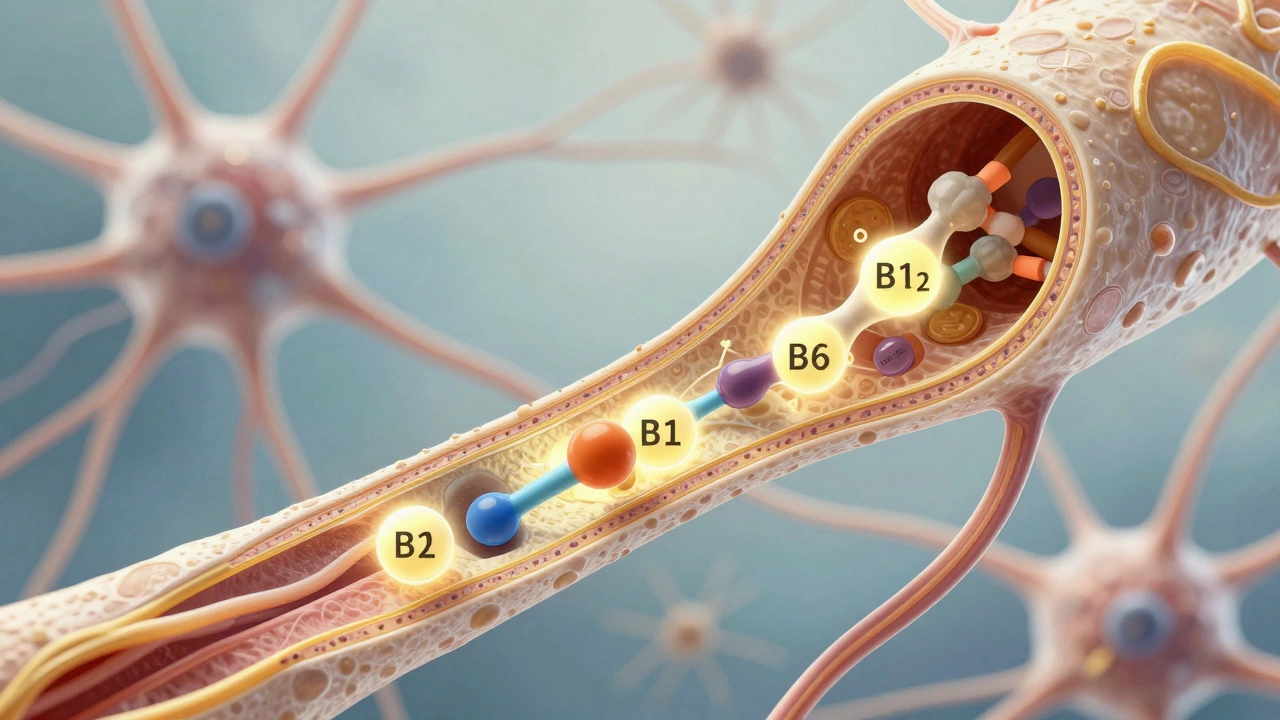
Nerves are made of long, delicate fibers wrapped in a fatty sheath called myelin. When that sheath breaks down or the fiber itself gets cut, signals slow down or stop. Healing doesn’t happen fast. It can take months. And without the right building blocks, your body can’t rebuild properly.Unlike skin or muscle, nerves don’t regenerate easily. But they can-if they get enough of the right vitamins. Research shows that certain B vitamins, antioxidants, and minerals directly support nerve repair. They help produce myelin, reduce oxidative stress, and improve blood flow to damaged areas.
Vitamin B12: The cornerstone of nerve repair
If you’re dealing with nerve damage, B12 should be your first stop. It’s not just important-it’s essential. Vitamin B12 plays a direct role in making myelin, the protective coating around nerves. Without enough B12, your nerves start to fray. That’s why deficiency is linked to numbness, burning feet, and balance problems.Studies show that people with diabetic neuropathy who took B12 supplements reported less pain and better nerve conduction after 12 weeks. One 2019 trial in the Journal of Clinical Neuroscience found that B12 injections improved sensation in 78% of patients with peripheral neuropathy.
But here’s the catch: B12 absorption drops with age, gut issues, or long-term use of acid-reducing drugs. Even if you eat meat, eggs, or dairy, you might still be low. Blood tests show levels below 300 pg/mL are often too low for nerve repair. Many experts recommend 1,000 mcg daily in methylcobalamin form for nerve health.
Vitamin B1 (Thiamine): The energy booster for nerves
Thiamine doesn’t build myelin, but it keeps nerves firing. Nerves need energy to send signals, and thiamine helps convert sugar into that energy. When you’re low on B1, nerves starve. That’s why alcoholics and diabetics-both groups with poor B1 status-often develop neuropathy.A 2020 study in Neurology found that high-dose thiamine (150-300 mg/day) improved nerve function in people with diabetic neuropathy faster than standard doses. It also reduced pain scores by nearly 40% over six months.
Thiamine works best when paired with B6 and B12. That’s why most nerve-support supplements combine them. Look for benfotiamine, a fat-soluble form that absorbs better than regular thiamine. It’s been used in Europe for decades to treat nerve pain.
Vitamin B6: The nerve signal regulator
B6 helps make neurotransmitters like serotonin and GABA, which control how nerves communicate. Too little can cause tingling. Too much? Also bad. High doses over 200 mg/day for long periods can actually damage nerves.The sweet spot is 10-50 mg daily. Most multivitamins have 2-5 mg-that’s fine for maintenance. But if you’re healing nerve damage, aim for 25-50 mg. Choose pyridoxal-5-phosphate (P5P), the active form your body uses directly. Avoid cheap pyridoxine HCl if you have liver issues or take medications.

Vitamin D: The hidden player in nerve healing
You’ve heard of vitamin D for bones. But it also regulates nerve growth factors. Low vitamin D levels are strongly tied to chronic pain and neuropathy. A 2021 meta-analysis in Pain Medicine found that people with neuropathic pain had 30% lower vitamin D than those without.One trial gave 50,000 IU weekly to patients with diabetic neuropathy. After 3 months, their pain dropped by half, and nerve conduction improved. Most people need 2,000-5,000 IU daily to reach optimal levels (40-60 ng/mL). Get your blood tested before starting high doses.
Alpha-lipoic acid: The antioxidant that heals nerves
This isn’t a vitamin, but it’s often grouped with them because it’s so critical. Alpha-lipoic acid (ALA) is a powerful antioxidant that reduces oxidative stress-the main reason nerves die in diabetes and aging.Multiple studies show ALA improves numbness and burning in diabetic neuropathy. One large trial gave 600 mg daily for 5 weeks. Patients reported less pain and improved sensation. Another study found ALA helped regenerate small nerve fibers after 4 months.
Take it on an empty stomach. 600 mg once a day is the standard dose. It’s safe, but can cause mild stomach upset in some. Look for R-ALA, the natural form-it’s more effective than the synthetic version.
How to combine these for maximum repair
No single vitamin fixes nerve damage. You need a team:- B12: 1,000 mcg daily (methylcobalamin)
- B1: 150-300 mg daily (benfotiamine)
- B6: 25-50 mg daily (P5P form)
- Vitamin D: 2,000-5,000 IU daily (based on blood test)
- Alpha-lipoic acid: 600 mg daily
Take these with food to reduce stomach upset. B vitamins are water-soluble, so your body uses what it needs and flushes the rest. That means daily dosing matters.
Some supplements combine all five. Check labels. Avoid ones with artificial fillers or unnecessary additives. Stick to brands that third-party test for purity (USP, NSF, or ConsumerLab certified).
What doesn’t work
There’s a lot of hype out there. Vitamin E? It helps with circulation, but no strong evidence it repairs nerves. Omega-3s? Good for inflammation, but not a direct nerve healer. Magnesium? Helps with muscle cramps, not nerve regeneration.Don’t waste money on miracle blends with 20 ingredients. Focus on the five proven ones above. And never skip medical treatment. Vitamins support healing-they don’t replace physical therapy, blood sugar control, or nerve decompression surgery if needed.

How long until you feel better?
Nerve healing is slow. Don’t expect results in a week. Most people notice reduced tingling or burning after 4-8 weeks. Better movement or sensation can take 3-6 months. Keep taking the supplements. Stop too soon, and you lose progress.Track your symptoms. Rate your numbness or pain on a scale of 1-10 every two weeks. If nothing improves after 6 months, talk to a neurologist. You might need nerve conduction tests or imaging to check for compression or other issues.
Who should avoid these supplements?
Most people tolerate these well. But:- Don’t take high-dose B6 if you have kidney disease or are on seizure meds.
- Don’t take ALA if you’re diabetic and on insulin-it can lower blood sugar too much.
- High-dose B12 is safe for most, but avoid if you have Leber’s disease (a rare genetic condition).
- Always check with your doctor if you’re on chemotherapy, blood thinners, or thyroid meds.
Even if you’re healthy, get a blood test before starting high doses. Too much of a good thing can backfire.
Real-life example: A patient’s journey
A 58-year-old woman in Bangalore developed numbness in her feet after 12 years of type 2 diabetes. Her doctor said it was permanent. She started taking B12 (1,000 mcg), benfotiamine (300 mg), P5P (50 mg), vitamin D (4,000 IU), and ALA (600 mg) daily. After 3 months, she could walk without dragging her feet. After 6 months, she no longer needed painkillers. Her nerve conduction test showed a 22% improvement.She didn’t cure her diabetes. But she gave her nerves the tools to heal.
Can nerve damage be reversed with vitamins alone?
Vitamins support nerve repair, but they don’t reverse all damage. If a nerve is crushed, cut, or compressed by a herniated disc, surgery or physical therapy may be needed. Vitamins work best when combined with blood sugar control, avoiding alcohol, and staying active. They’re part of the solution-not the whole fix.
Which form of B12 is best for nerve repair?
Methylcobalamin is the most effective form for nerves. It’s the active version your body uses directly to repair myelin. Cyanocobalamin, the cheap form in many multivitamins, must be converted first-and many people, especially older adults, can’t do that well. Always choose methylcobalamin for nerve health.
How long should I take these vitamins for nerve damage?
At least 6 months. Nerve regeneration takes time. Some people continue long-term, especially if they have chronic conditions like diabetes. There’s no harm in continuing if you feel better and your doctor approves. Stopping too early can cause symptoms to return.
Can I get enough of these vitamins from food?
You can get B12 from meat, eggs, and dairy-but absorption drops with age. B1 is in whole grains and pork, but modern diets lack enough. ALA is in spinach and broccoli, but you’d need to eat pounds daily to match supplement doses. For nerve repair, food isn’t enough. Supplements are necessary to reach therapeutic levels.
Do these vitamins help with sciatica or pinched nerves?
They help reduce inflammation and support healing after the pressure is relieved. If your sciatica is from a herniated disc, vitamins won’t fix the disc. But once you’ve had physical therapy or surgery, these nutrients help nerves recover faster and reduce lingering pain or numbness.
Next steps: What to do today
1. Get a blood test for vitamin B12, vitamin D, and HbA1c (if diabetic). 2. Start with a daily stack: 1,000 mcg methylcobalamin, 300 mg benfotiamine, 50 mg P5P, 4,000 IU vitamin D, and 600 mg alpha-lipoic acid. 3. Track symptoms weekly. 4. Talk to your doctor about physical therapy or nerve gliding exercises. 5. Avoid alcohol and sugar-they slow healing.Healing nerve damage isn’t quick. But with the right nutrients and consistent care, many people regain function they thought was lost forever.